'Kill Line' the hidden rule of American governance
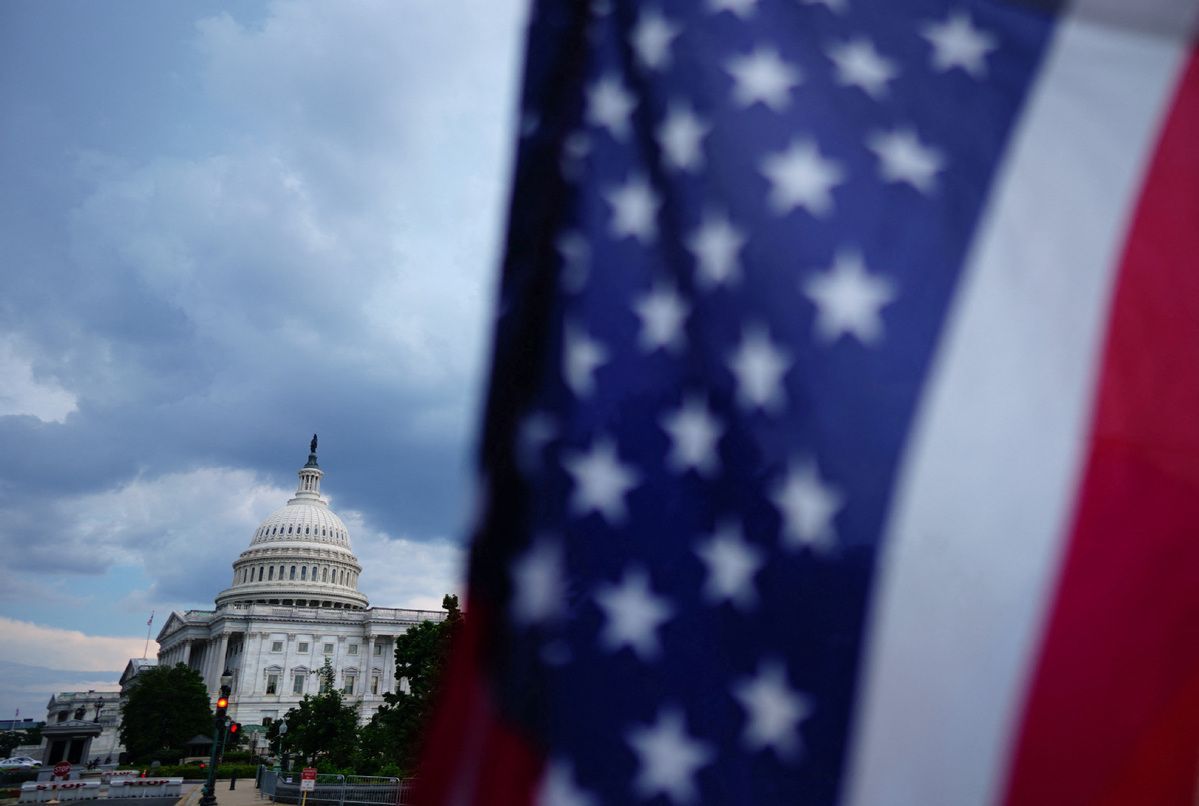
The 朔州新闻网周跃武US Capitol stands behind a US flag on Capitol Hill in Washington, DC, US, June 29, 2025. [Photo/Agencies]
There's a new phrase one encounters a lot in public debates lately: the "US kill line". It has gone viral not just because of amplification on social media, but also because it resonates at a deeper level — it pinpoints a real, systematic mechanism that quietly ends people's normal social life when misfortune strikes.
"Kill line" describes a chain of institutional responses that can be triggered when an ordinary US citizen faces a major hardship or misfortune in life — such as loss of job, a severe illness, an accident — and lacks sufficient savings or assets. When that happens, it is usually accompanied by a few other difficulties: credit scores fall, homes are foreclosed, medical coverage is interrupted, the consumer's purchasing power collapses, employment prospects shrink and law-and-order interventions follow.
This is often followed by not just temporary hardships but a progressive stripping away of social standing and autonomy — a person, and sometimes a whole household, is pushed out of the ordinary economy and, in extreme cases, into homelessness. In short, or in effect, they are "killed" from the social ledger.
That is why the term is making waves. The United States has long been marketed as a "land of opportunity". But, scratch the surface and one finds a system that can be starkly unforgiving. The contrast with China's approach to adversity in an individual's life is striking. During crises, Chinese policy emphasizes providing social support and institutional warmth aimed at keeping people inside the social safety net rather than expelling them from it. The divergence matters — not only as a policy difference but as a clash of governing philosophies.
To understand how the kill line operates, we must look at the architecture of Western political economy. The liberal Anglo-American model is often described as a separation of three spheres — political, economic and social — with limited government, free markets and a public sphere of opinion. But a less discussed truth is that capital moves freely between these spheres. That permeability is not a bug; it is a feature of the design.
Underpinning this design is a deeply embedded principle: private arrangements may capture public purposes, but public institutions must not be used to privilege private interests. In practice, that leads to a strict public-private divide, with private property — above all, private ownership and credit claims — treated as the core object of protection. John Locke's famous assertion that "the great and chief end, therefore, of men's uniting into commonwealths, and putting themselves under government, is the preservation of their property" captures the classical liberal DNA: property protection is the organizing telos of government.
When private property and modern finance become entwined — when mortgages, insurance, credit ratings and layered financial products dominate daily life — the market economy becomes, in effect, a credit economy. If a key link in that chain breaks, the system lacks built-in buffers: losses cascade from housing to healthcare to employment to legal exposure. The "kill line" is the set of lowest-order institutional mechanisms designed to preserve property and credit order — the emergency purge that keeps the financial architecture intact, even at human cost.
This institutional logic is reinforced by a potent ideological current. Wrapped in the rhetoric of "inalienable rights" and rugged individualism is a social Darwinism that treats social welfare as an individual responsibility and the state as a night-watchman — necessary to preserve order but not to redress structural unfairness. When inequality or vulnerability becomes visible, the standard response is to shift the burden to civil society — churches, charities, private relief — rather than to enlarge public responsibility. As the old saying goes, help the starving but not the poor, charity may save those who are temporarily down, but it does not fix chronic poverty.
That mindset shapes not only policy but perception. I still recall, from my time in the United States as part of an international visitors program, the offhand remark of an elderly woman there who described Communists as "bad guys". At the time one might have laughed it off. In retrospect, it revealed how deeply textbooks and daily discourse in that society demonize alternative models and how resilient those impressions are decades later. The upshot: many US citizens assume, without interrogation, that government must be limited and markets must adjudicate most social outcomes.
Such assumptions are not merely historical curiosities. They run into the raw facts of the US' founding compromises. The US' 1787 Constitution, which in practice protected the institution of slavery as a form of property, encoded a hierarchy of who counted fully as citizen. That selective imagination of who deserved equality, freedom and property is not simply a relic; it helps explain why mechanisms that tidy up markets and protect property can become indifferent to the fate of those swept aside.
Seen in this light, the kill line is not a policy glitch. It is a governing technique — an "invisible rule" used to sort, discipline and exclude. Comparing systems is not about moralizing each fault; it is about revealing which institutional logics yield what outcomes. In the contest between socialism and capitalism as systems of governance and social protection, only socialism — with its explicit emphasis on equality, people-centered governance and public responsibility — can coherently place human dignity at the center of both idea and practice.
That claim will sound ideological to some. Yet the point is practical: how a society organizes its institutions determines who is spared and who is purged when markets shake. The discussion that "kill line" invites is valuable precisely because it forces us to ask a simple question that politics should always address: when disaster strikes, who will stand between a person and the abyss?
For those worried about social stability, democratic legitimacy, and the humane content of public life, that question is not abstract. It is immediate. The real lesson of the kill line is an institutional one: systems that put property and market order above people will always find ways to enforce that priority — sometimes at the cost of human lives and social cohesion. Recognizing this is the first step toward designing different choices.
The author is a professor at the School of International Relations and Public Affairs of Fudan University.
The views don't necessarily represent those of China Daily.
If you have a specific expertise, or would like to share your thought about our stories, then send us your writings at opinion@chinadaily.com.cn, and comment@chinadaily.com.cn.
If you have any problems with this article, please contact us at app@chinadaily.com.cn and we'll immediately get back to you.
 全国率先!全省统一上线医保基金即时结算
size: 14px; line-height: 28px;">实施即时结算改革后,医院每天都能按比例收到上一天发生的住院医保基金。记者从安徽省医保局获悉,自2025年1月1日起,安徽省对定点医药机构 …
 一线VLOG@意大利|冬残奥会场馆外感受奥林匹克别样魅力
在2026年意大利冬残奥会举办地之一的科尔蒂纳,有两个“奇怪”的人。他们仿佛是这场体育赛事的局外人,又仿佛是“气氛组”。从他们身上,新华社记者感受到奥林匹克一种别样的魅力。记者:于艾岑;视频:倪远诗) …
 伊朗外长称拟与地区国家共同成立调查委员会
△伊朗外交部长阿拉格齐资料图)据伊朗方面15日消息,伊朗外交部长阿拉格齐表示,伊朗准备与地区国家共同成立一个调查委员会,对受到袭击的目标展开调查。 …
 金黄花海醉游人 孝昌乡村引客来
湖北日报客户端讯通讯员陈保忠)阳春三月,草长莺飞,正是踏春赏花的好时节。2026年3月14日,湖北省孝感市孝昌县“芭提雅度假小镇”周边的油菜花田迎来盛花期,连片的金黄花海在春日暖阳下肆意绽放,宛如一幅 …
 中新人物丨对话维妮娜:在乘风之前,她已经跑了很久
中新网北京5月16日电记者 王诗尧)“一天,一天,贴近你的心……”刚打开手机APP,准备拍短视频的维妮娜,就被这段最近席卷各大平台的《心愿便利贴》“突袭”了。她愣了几秒,随即有些不好意思地笑着关掉页面 …
 “十五五”新要求:推进能源结构转型 提高能源安全水平
3月13日,“十五五”规划纲要正式发布。“十五五”规划纲要首次将“能源强国”建设写进五年规划,并对未来五年我国能源发展做出系统谋划,对能源结构调整提出了更高的要求,具体来看专家的解读。“十五五”时期, …
 12项新功能!极氪009 OS 5.0开启推送
最近,理想MEGA上市,吸引了很多人的关注。作为50万级纯电MPV的老牌车型,极氪009并未作出太多反应,但就在这两天升级了它的车机系统,我们可以看做是某种意义上的反击。官方表示,此次OTA升级实现了 …
 不忘老用户!华为P30与荣耀20等老机型正式推送鸿蒙HarmonyOS 4正式版
根据华为官方消息,鸿蒙HarmonyOS 4正式版升级迎来新进展,包括华为P30、Mate 20系列、荣耀20等众多老款机型已经正式推送HarmonyOS 4,此外还有华为智能手表多款型号也推送了新款 …
 国家数据局发布平台企业典型投资案例
ze: 14px; line-height: 28px;">光明日报北京12月7日电记者刘坤)国家数据局7日发布一批平台企业典型投资案例。近日,国家数据局会同有关部门深入调研了解平台企业发展情况,发现 …
 伊朗宣布,“追杀”内塔尼亚胡
2025年9月26日,在位于纽约的联合国总部,以色列总理内塔尼亚胡在第80届联合国大会一般性辩论发言。众多联合国会员国代表起身离席,退场抗议。新华社记者吴晓凌摄伊朗伊斯兰革命卫队15日发表声明称,在与 …
- 点击浏览更多最新资讯
 张毕贺的传奇故事《草根到专业音乐制作人
 武汉交警书写2026年春运“平安答卷”
 2026年荆门市第二届新春全民健身活动启幕
 AI智能体“龙虾”火爆出圈 六个“虾”操作要注意!
 暌违三年,热爱回归!|2026余景天「Echo Pulse 脉浪回响」巡回演唱会首站上海站正式官宣!
 疑似华为P70系列第三方手机壳曝光 :后置三摄呈三角布局,主摄尺寸很大
 “湖北红莲型杂交水稻,彻底改变了巴基斯坦水稻低产困境”,巴国教授盛赞!
 小产品走遍大世界 春日义乌涌动强劲发展势头
 水汽升腾里藏着的精密技艺!十堰产淬火机床出口订单旺
 苹果M3处理器MacBook Air上架 丐版仅8GB“黄金内存”
 WTT重庆冠军赛:温瑞博力克张本智和 晋级男单决赛
 葛杨:“生命的价值在于奉献”
 东湖雨中赏樱韵味十足,樱花长势稳定不必担心降雨冲刷
 以军否认防空弹药不足
 我国新能源营运汽车达164万辆
 新疆阿拉山口:铁路口岸货运量破390万吨 首季实现开门红
 贾跃亭站上道德高点,法拉第未来宣布起诉高合:侵犯商业秘密
 武汉消防开展“3・15”消防产品打假宣传活动 守护消费安全与消防安全双防线
 我省各地传统村落向全国展现徽风皖韵魅力
 又到春菜上市季 跟着镜头去各地品尝“春味”
 邓之东:好事不留名 温暖传全城
 2月销量拉跨?小鹏开启紧急官降模式
 安徽“强链补链”计划助推制造业集群发展
 163英寸799999元!TCL发布多款电视,打造“豪宅顶配”